

The statement issued by SKM spokesperson Yougan Tamang attempts to portray the Government of Sikkim’s recent austerity measures as an act of visionary leadership responding to global economic instability. However, what the people of Sikkim are witnessing today is not merely fiscal caution, but a desperate attempt by the government to justify administrative failures, policy confusion and economic mismanagement by hiding behind international events.
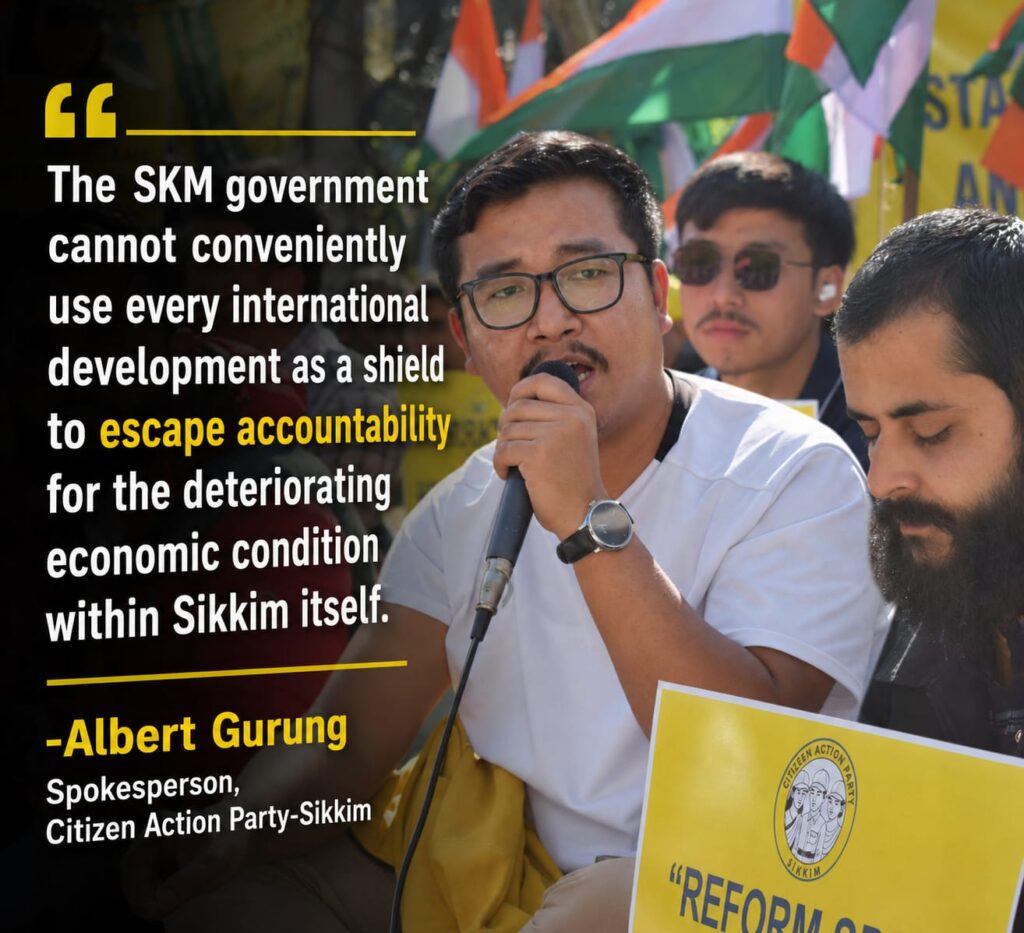
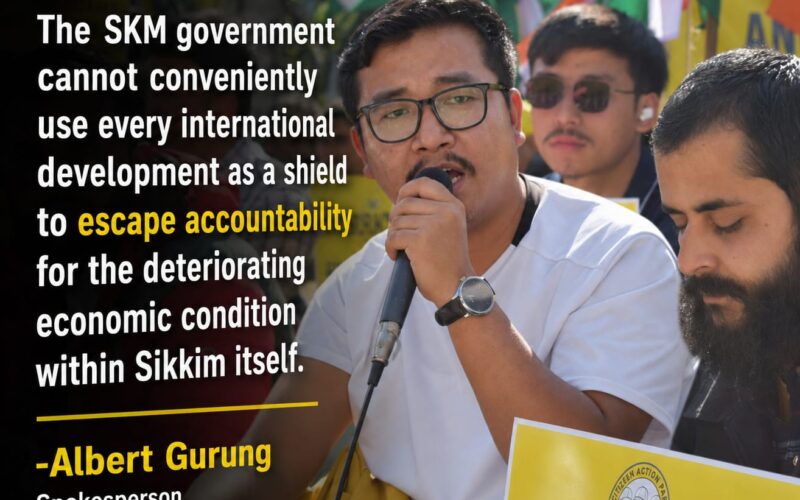
No responsible opposition denies that global economic uncertainties exist. The ongoing geopolitical tensions in the Middle East, fluctuations in crude oil prices and supply chain disruptions are realities affecting many nations, including India. However, the SKM government cannot conveniently use every international development as a shield to escape accountability for the deteriorating economic condition within Sikkim itself.
The fundamental question before the people is simple: if the state’s finances were healthy and governance efficient, would the government need to impose sudden austerity measures that directly inconvenience ordinary citizens? The truth is that Sikkim’s present fiscal stress did not emerge overnight because of an international conflict. It is the cumulative result of years of unchecked expenditure, politically motivated populism, lack of financial transparency, ballooning liabilities and the absence of long-term economic planning under the SKM government.
The spokesperson speaks repeatedly about “responsible governance” and “fiscal discipline.” But true fiscal discipline begins long before a crisis. It begins with prudent borrowing, transparent utilisation of public funds, controlling unnecessary expenditure and creating sustainable revenue systems. One cannot spend recklessly for years and suddenly claim moral authority on austerity after the treasury begins to feel pressure.
The government also attempts to compare its present measures with national-level crisis management undertaken by the Government of India during previous global shocks. Such comparisons are misleading. The Government of India operates with vastly different institutional capacity, economic scale and fiscal instruments. Sikkim’s situation today is not merely the result of global inflation but of poor state-level financial management that has weakened the state’s ability to absorb external shocks.
Most importantly, the SKM government is deliberately presenting the opposition’s criticism as “anti-national” or “politically motivated” simply because questions are being raised. In a democracy, questioning government decisions is not irresponsibility; it is accountability. The opposition is not opposing austerity for the sake of politics. We are questioning the absence of transparency, the selective nature of restrictions and the failure of the government to clearly explain why ordinary citizens must bear the burden while systemic inefficiencies within governance remain untouched.
The odd-even vehicle policy, for instance, was introduced without adequate consultation, planning or assessment of its practical impact on daily commuters, small businesses, students and workers. Policies affecting people’s livelihoods cannot be implemented through administrative shock therapy while expecting citizens to silently accept every inconvenience in the name of patriotism.
Furthermore, if the government truly believes that global uncertainty demands collective sacrifice, then the people deserve complete transparency regarding the financial condition of the state. How severe is the fiscal situation? What are the exact revenue deficits? Which sectors have witnessed overspending? What cost-cutting measures are being implemented within the government itself? Have luxury expenditures, unnecessary political appointments and administrative excesses been reduced? Fiscal responsibility cannot become a one-sided burden imposed only upon the public.
The SKM spokesperson cites alarming statistics regarding fuel imports, fertiliser costs, inflation and stock market volatility. These are indeed serious national concerns. But instead of merely using national crises as political justification, the people of Sikkim expect the state government to present a concrete economic roadmap for local resilience. Where is the strategy for strengthening local production, tourism sustainability, youth employment generation, agricultural self-reliance and revenue diversification? Governance requires solutions, not only speeches about global problems.
The Citizen Action Party-Sikkim firmly believes that genuine leadership during difficult times must be transparent, consultative and accountable. Responsible governance does not mean suppressing criticism or branding every opposing voice as insensitive to national interest. Democracies function best when governments are questioned and policies are openly debated.
Sikkim’s people are mature enough to understand global economic realities. What they are unwilling to accept is the continued attempt by the government to divert attention from its own administrative shortcomings by invoking international conflicts every time questions arise.
At this crucial moment, the government must stop political grandstanding and start engaging honestly with the people. Fiscal discipline should begin with accountability at the top, not inconvenience at the bottom. The people of Sikkim deserve transparency, competence and sincere governance — not fear-driven narratives designed to silence democratic criticism.
—Albert Gurung
Spokesperson
Citizen Action Party-Sikkim
